



Accelerating Flavivirus Therapeutics: Validated Assays from Discovery to Dose


The Flavivirus Global Outlook: Navigating the Gap Between Research and Commercial Success

The global threat posed by flavivirus strains—including Dengue, Zika, West Nile Virus, and Yellow Fever—is no longer a distant concern for tropical regions. With climate change expanding the reach of mosquito vectors, the race for antiviral therapeutics and vaccine development has reached a critical financial and clinical juncture.

For scientists in infectious disease research, understanding the “commercial wall” is as vital as understanding the viral genome. While billions are invested annually, the path to regulatory submission remains one of the most challenging in modern medicine.

The Current Commercial Landscape: What is Actually Available?

Despite decades of research, the cupboard for FDA-approved flavivirus therapeutics remains surprisingly bare.

  • Yellow Fever: The YF-17D vaccine remains the gold standard of efficacy, though it is a decades-old technology.
  • Dengue: Progress has been made with Dengvaxia (Sanofi) and the more recent QDENGA (Takeda). However, market challenges persist; notably, Sanofi recently announced the discontinuation of Dengvaxia production due to shifting global demand and the complexities of pre-vaccination screening requirements.
  • Zika and West Nile: There are currently no FDA-approved vaccines or specific antiviral drugs for Zika or West Nile Virus. Treatment remains entirely supportive, leaving a massive opening for drug discovery programs.

Accelerating Your Pipeline: From Bench to Clinic

To bridge the gap between a promising lead and a commercial product, researchers must utilize validated models that satisfy rigorous regulatory submission standards.

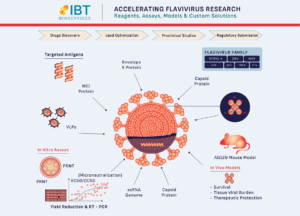
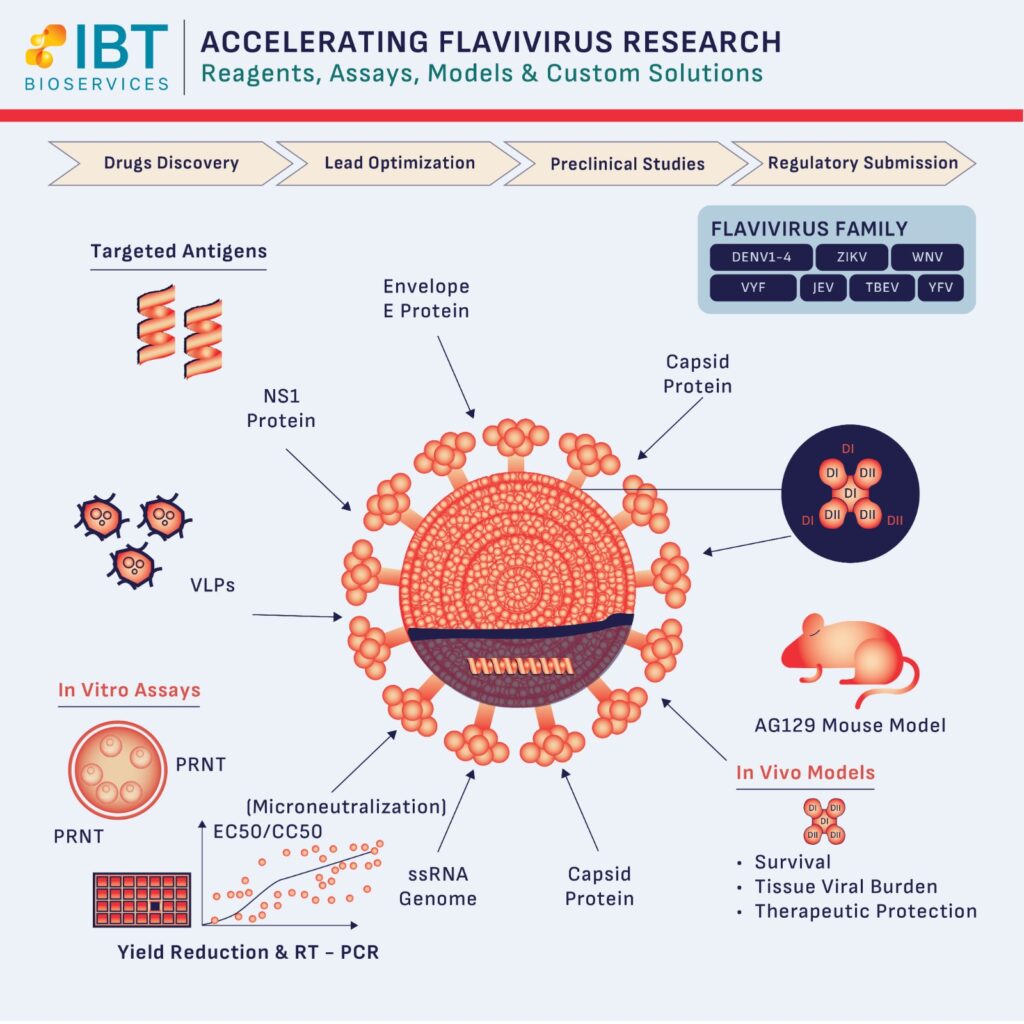
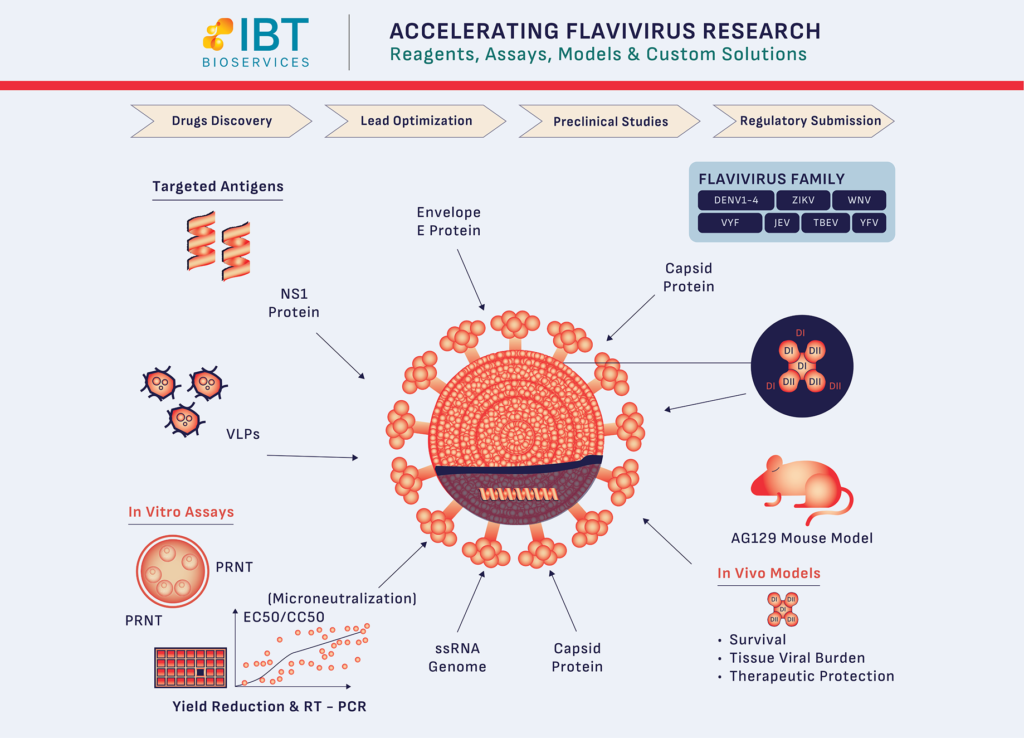
  1. Lead Optimization: Speed is the only way to combat funding volatility. Utilizing in vitro antiviral assays—such as Plaque Reduction Neutralization Tests (PRNT) and Microneutralization (MN)—allows for the rapid determination of EC50 and CC50 values.
  2. In Vivo Efficacy Assessment: The AG129 mouse model remains the essential bridge. Because it accommodates non-adapted flaviviruses, it provides the most accurate data for survival, viral reduction and therapeutic protection.
and vaccine candidate evaluation.
  3. Custom Assay Development: As new strains emerge, “off-the-shelf” solutions often fail. Customising ELISA testing, viral neutralisation assays, custom animal models assays ensures that your data reflects the current reality of the field.
  4. Clinical Assay Strategy:  Lead candidate selection transitions into the development and validation of high-stakes assays for product release, MOA, and clinical trial endpoints.

Strategies to Accelerate Your Research and Development

Whether you are optimizing a neutralizing antibody or validating a new vaccine development platform, your success depends on the precision of your reagents and the reliability of your models.

1. Targeting the Right Antigens: The Foundation of Discovery

The first hurdle in flavivirus research is often the availability of high-quality reagents. Research is only as good as the antigens used. By utilizing a wide array of virus particles, virus-like particles (VLPs), and recombinant proteins—such as NS1 and Envelope (E) proteins—researchers can better understand the antibody response and immunogenicity of their candidates.

IBT Bioservices supports this foundational stage by providing specialized reagents that target diverse antigens across the flavivirus family, ensuring your ELISA testing and serology work is both accurate and reproducible.

2. High-Throughput Screening: Identifying Lead Candidates

In the lead optimization phase, speed and precision are paramount. Utilizing in vitro antiviral assays allows for the rapid assessment of a compound’s efficacy.

  1. The Gold Standard: Plaque Reduction Neutralization Tests (PRNT) remain the industry benchmark for measuring neutralizing capacity.
  2. Efficiency at Scale: For larger libraries, Microneutralization (MN) and CPE assays offer automated, high-throughput alternatives to determine EC50 and CC50 values.
  3. Direct Quantification: Yield Reduction Assays provide a granular look at how a therapeutic reduces infectious viral load across various dose ranges.

3. Bridging the Gap: The Power of the AG129 Mouse Model

One of the greatest obstacles in preclinical studies is finding an animal model that accurately mimics human disease without the need for mouse-adapted viral strains.

The AG129 mouse model has emerged as a critical tool for this transition. Because these mice are deficient in IFN alpha-beta and gamma receptors, they are highly susceptible to non-adapted flaviviruses, allowing researchers to study:

  1. Viremia reduction and survival rates.
  2. Therapeutic candidate evaluation through lethal challenge.
  3. Complex pathologies, including neurotropism and vertical transmission.

4. Bespoke Solutions for Unique Research Goals

No two antiviral drug development programs are identical. Sometimes, “off-the-shelf” isn’t enough. Custom assay development allows researchers to adapt platforms to emerging strains or novel mechanisms of action, providing the robust data necessary for a successful regulatory submission.

The Economics of R&D: USA vs. The World

The financial engine driving flavivirus research is heavily centralized. Global investment in neglected and emerging infectious diseases (EIDs) is estimated in the billions, but the distribution of these funds highlights a significant reliance on American infrastructure.

  1. The U.S. Dominance: Historically, the United States accounts for approximately 50% of all global health R&D funding. Within this, the NIH (National Institutes of Health) is the titan, responsible for nearly 38% of the world’s total spend on global health research.
  2. The Global Split: Outside the U.S., funding is a mix of philanthropic giants like the Wellcome Trust (UK) and the Gates Foundation, alongside government-led initiatives in the UK, Japan, and the EU. While the U.S. leads in early-stage, “high-risk” basic research and preclinical studies, other nations are increasingly focusing on localized viremia surveillance and late-stage implementation.
  3. A Shifting Tide: Recent budgetary discussions in the U.S. have projected potential cuts to global health R&D. For flaviviruses like Zika, some analysts predict a possible 8% reduction in NIH funding, making the role of efficient, high-throughput virology CROs more critical than ever to stretch every research dollar.

Accelerate Your Program

From benchtop screening to sophisticated in vivo modeling, having an integrated partner can significantly reduce the time to market for antiviral therapeutics.

Ready to move your flavivirus research forward? Contact IBT Bioservices today to learn how our specialized reagents and virology CRO expertise can provide the critical data you need for your next breakthrough.

References:

  • Agrawal, S., & Chen, L. (2025, January). Development of nucleic acid-based vaccines against dengue and other mosquito-borne flaviviruses. Frontiers in Immunology, 16, Article 110245.
    Gomez, R. T., & Miller, H. (2025, September). Orthoflavivirus vaccine platforms: Current strategies and challenges. Vaccines, 13(9), 842.
    Sato, K., & Williams, J. (2025, November). Advances and challenges in vaccination strategies against Japanese Encephalitis. Tropical Medicine and Infectious Disease, 10(11), 312.

Chat with our team?

Leverage our scientific expertise to design a high-impact study for your project.


need a referral?

Our existing partners love boasting about our collaborations! We are happy to provide referrals if needed.

Tell Us About Your Enquiry

    Share This

    Facebook
    Twitter
    LinkedIn

    CATEGORIES

    RECENT POSTS

    SUBSCRIBE HERE!

    Subscribe to the IBT Bioservices Tech Talk list and receive periodic updates on industry news and IBT Bioservices products and services.

    Search
    Generic filters