


Combating the 2026 Bundibugyo Outbreak: How IBT Bioservices Accelerates Vaccine and Therapeutic Development

The spring of 2026 has brought a stark reminder of the unpredictable threat posed by filoviruses. On May 16, 2026, the World Health Organization (WHO) officially designated the rapidly expanding Ebola disease outbreak caused by the Bundibugyo virus (BDBV) in the Democratic Republic of the Congo (DRC) and Uganda as a Public Health Emergency of International Concern (PHEIC). With hundreds of suspected cases and a compounding humanitarian crisis in the Ituri Province, global health organizations like CEPI and WHO are mobilizing immediate countermeasure strategies.
Unlike the more common Zaire ebolavirus strain, there are currently no FDA-approved vaccines or specific therapeutic treatments for the Bundibugyo strain. Existing standard countermeasures—such as the Ervebo (rVSV-ZEBOV) vaccine—do not reliably protect against BDBV, creating a critical vulnerability in global biodefense.
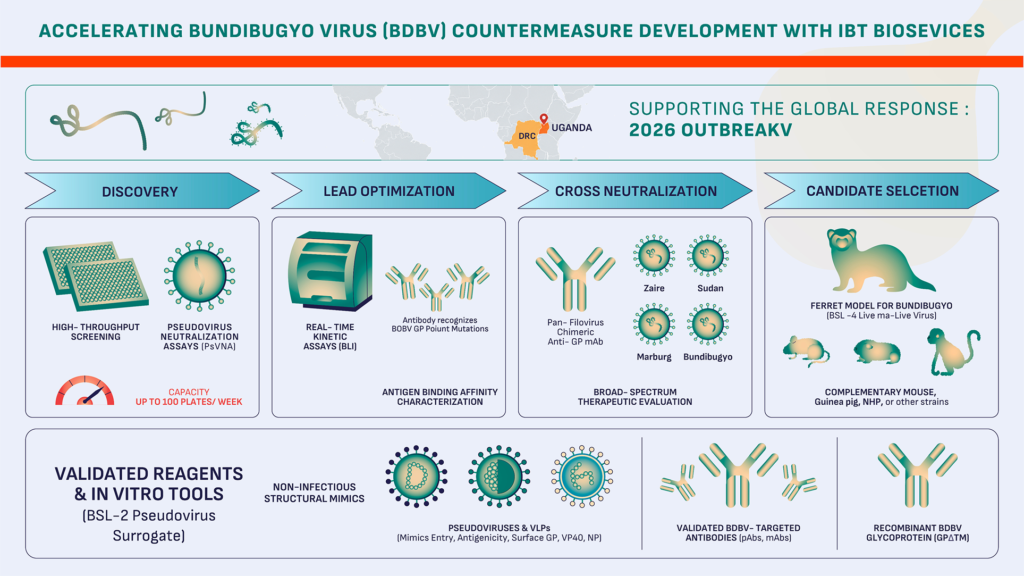
To close this gap, drug developers require reliable, high-capacity pipelines to safely evaluate vaccines, small-molecule inhibitors, and cross-neutralization therapeutics. As an established leader in infectious disease contract research, IBT Bioservices, building upon decades of experience of its founders and scientists with filoviruses, provides the end-to-end preclinical services and specialized reagents needed to move BDBV candidates rapidly from Discovery to Candidate Selection.

The Preclinical Challenge: BSL-4 Bottlenecks and Cross-Neutralization

Developing countermeasures against BDBV requires evaluating target mechanisms like viral attachment, fusion inhibition, and antibody-mediated clearance. However, traditional wild-type filovirus research requires restricted, high-containment Biosafety Level 4 (BSL-4) facilities, introducing severe operational and geographic bottlenecks.

IBT Bioservices, through its established relationship with BSL-4 labs and its staff experience with BSL-4 models for Ebola viruses can provide a rapid access to BSL-4 testing upon initial evaluation in surrogate models.

IBT Bioservices maintains a robust, ready-to-ship catalog of specialized reagents tailored specifically for BDBV research, enabling teams to perform precise assays on their own benchtops:

Formulated using recombinant Vesicular Stomatitis Virus expressing the Bundibugyo Ebola glycoprotein (rVSV-BDBV-GP). These replication-incompetent tools safely mimic wild-type viral entry, allowing for high-throughput screening in standard BSL-2 laboratories.

Highly pure, mature, His-tagged Bundibugyo ebolavirus glycoprotein engineered minus the transmembrane domain. Produced in an insect cell expression system (Sf9) and purified by FPLC, it serves as the ideal antigen for binding assays and vaccine immunogenicity evaluations.

Our catalog features affinity-purified Rabbit anti-BDBV GP polyclonal antibodies (pAb), fully validated for Western Blotting and ELISA characterization.

For programs evaluating broad-spectrum therapies, our Pan-filovirus Chimeric anti-GP mAb offers established cross-reactive binding across Zaire, Sudan (Boniface), Bundibugyo, and Marburg lineages.

Whether screening small-molecule entry blockers or characterizing vaccine-induced antibody portfolios, IBT’s laboratory infrastructure provides the capacity to sustain demanding timelines:

1. Pseudovirus Neutralization Assays (PsVNA):

Recognized as the gold standard for safely quantifying neutralizing antibody responses and screening small-molecule fusion inhibitors. IBT possesses the operational capacity to test up to 100 plates per week. Additionally, our molecular biology team can custom-engineer novel, site-specific mutant or newly sequenced VSV variants to test against emergent clinical isolates.

ELISA Testing and Custom Kits

Precision binding kinetics and quantification platform profiling responses to wild-type glycoproteins (GP), soluble glycoproteins (sGP), or specific GP point mutations. Complete BDBV ELISA kits are available upon request.

Octet (Biolayer Interferometry - BLI):

Real-time, label-free kinetic analysis to map precise association (Kon), dissociation (Koff), and overall binding affinities (KD) between your therapeutic leads and target filovirus antigens.
Advanced In Vivo Efficacy Validation

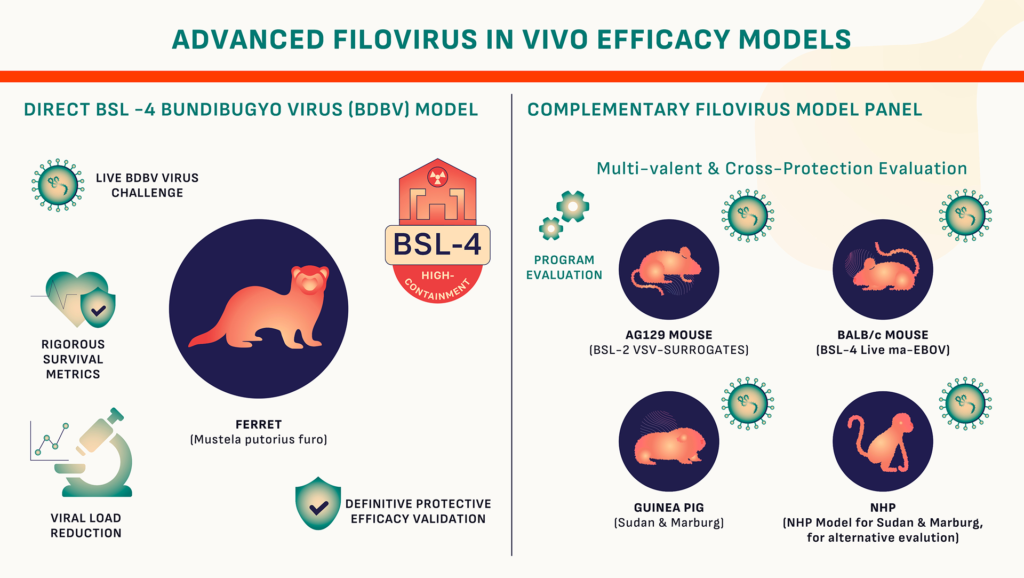
Transitioning from in vitro optimization to formal candidate selection requires robust animal models that mimic human disease presentation. IBT Bioservices bridges this gap by supporting critical translational in vivo models across varying biosafety levels:

Ferret Model for Bundibugyo:
Supported directly within BSL-4 high-containment, utilizing live virus challenges to rigorously validate survival metrics, viral load reduction, and the definitive protective efficacy of your vaccine candidates or small-molecule therapeutics.

Complementary Filovirus Models:
To assist cross-protection and multi-valent program evaluation, IBT regularly conducts in vivo efficacy studies utilizing AG129 mice (BSL-2 VSV-surrogates), BALB/c mice (Live ma-EBOV at BSL-4), and Non-Human Primate (NHP) or Guinea Pig models for Sudan and Marburg strains.

Partner with IBT Bioservices: Accelerating Global Health Responses

With the 2026 emergency actively evolving, the window to advance effective BDBV therapeutics is narrow.

By combining our high-throughput BSL-2 screening capabilities, highly specific catalog reagents, and high-containment animal challenge infrastructure, IBT Bioservices serves as a seamless extension of your research organization.

Ready to accelerate your filovirus program?

Contact the IBT Bioservices scientific team today to request a quote or schedule a technical consultation regarding your BDBV assay or reagent needs.

I have a specific protocol in mind

I need help choosing the right model

I want to see your other viral capabilities

I want to see your immunology capabilities

Search
Generic filters